Sermons at Union Congregational Church
Preached by The Reverend Gail L. Miller, Pastor
October 1, 2017 Seventeenth Sunday after Pentecost
I Corinthians 10:1-13
God Won’t Give You More Than You Can Handle
(based on the book Half Truths, by Adam Hamilton)
I enjoy a good bumper sticker as much as the next person – pithy, clever, catch phrases designed to be remembered and shared. We came up with our church’s “bumper sticker” tag line – Sharing Christ, Changing Lives – for just that reason.
Though to be honest some of the Christian bumper stickers I see can make me cringe or at least roll my eyes. Here’s one I saw recently: If God brings you to it, he’ll take you through it. (The whole thing hangs on that little word, “If.”)
Sometimes our faith fits on a bumper sticker, sometimes it doesn’t. I even came up with my own bumper sticker about that…. If your faith can fit on a bumper sticker, it’s too small!
Sometimes what the Christian faith has to say about a certain idea or situation is more than can fit on a bumper sticker, and so it’s good for us to go deeper into sayings like: God doesn’t give us more than we can handle.
Typically, this saying is TRYING to be comforting…
I know you’re going through a tough time right now, and it’s a LOT. But it’s going to be all right; you’ll make it through. Remember – God never gives us more than we can handle.
It’s an attempt at encouragement, and it comes from I Corinthians 10:13. But notice what it actually says: No temptation has seized you that isn’t common for people. But God is faithful. He won’t allow you to be tempted beyond your abilities. Instead, with the temptation, God will also supply a way out so that you will be able to endure it.
Sometimes “tempted” is translated as “tested” but this sentence is in the middle of a section on temptations, so it’s pretty clear what he’s talking about.
Corinth was (and is) an international port city. It was a lively, bustling place where people from all over the world would arrive to buy and sell. It was the place where many religions converged, including pagan religions with temples to their gods where sacrifices of many kinds were made, and immorality ruled! In the Roman world “to live like a Corinthian” was synonymous with drunkenness and promiscuity.
Most of the people in Paul’s church had come from these other religions and were trying to leave them behind. Temptation was everywhere, and it was bound to be strong among those who had spent most of their lives immersed in pagan practices. They were trying to follow Jesus, but some of them were going back to their former ways, and Paul was trying to help them.
So the context for this verse is self-discipline in the face of temptation with the hope of avoiding sin – especially sexual immorality and idolatry.
Paul reminds them – and us – that these temptations have been around a long time. The Israelites in the wilderness faced adverse consequences of similar temptations thousands of years before.
We are all tempted. This passage is not about God not giving you more burdens in life than you can handle. It is about God helping you when you are tempted or tested. The Good News is that God will NOT allow us to be tempted beyond our abilities. Instead, He will always supply us with a way out.
A little different that where we began – right?
Then there’s the way that this saying – God won’t give you more than you can handle – can be the WRONG – even hurtful – thing to say.
In Half-Truths, Adam tells the story of someone he knew who told him,
For years this statement helped me when I was facing difficult things. It reassured me that somehow I was going to make it through. Then one day I was at my therapist’s office and mentioned it to him. He laughed and said, ‘Are you kidding me? Surely you don’t really believe that. I can tell you plenty of stories about people who had more than they could handle. In fact, my profession consists of helping just such people.
The counselor reminded her that even she had come to him because the emotional pain and difficulty she was facing had been more than she could handle. In addition, the woman’s mother had committed suicide because life had become more difficult than she could handle.
At first she was angry that her therapist had called her belief into question. But the more she thought about it, the more she realized that he was right. Maybe sometimes we do face situations that truly are more than we can handle, and that’s why we turn to others, especially those who love us, for help.
The problem with this saying is the first four words. God won’t give you…. Because when we say them, we are saying that whatever difficult or painful things are happening in your life, God gave them to you.
It’s as if we’re saying, “God gave you this horrible, painful, hurtful thing – but he’ll stop giving you more suffering before you reach your breaking point, so don’t worry!” YUCK!
Three weeks ago – the first sermon in this series explored the notion that Everything Happens For A Reason. And we considered how God doesn’t make EVERTHING happen, that sometimes WE make things happen, or ACCIDENTS happen, or illnesses happen… that free will is what makes us human, and God allows us to make mistakes, which means we will suffer from others’ decisions as well as our own.
I can’t say it more plainly – God does not cause you harm and suffering.
In recent years, when I’ve done funerals for someone who has died suddenly and too young, especially when there are kids involved, whether having lost a parent or sibling or friend, I make sure to find a private moment with the family before the service and I speak right to them, saying something like this….
• God did NOT do this. You are suffering to be sure, but God is not the cause of it. People will say things to you and they’re trying to help, but they may not be getting it right.
• “God needed another angel” – NO – he doesn’t NEED more angels and he certainly wouldn’t kill someone if he did.
• “God took her.” – NO – God doesn’t take people like this – God receives people, but he doesn’t snatch them from us.
• God does not decide “this one gets cancer” “this one will have an accident.”
Pain, suffering, loss, illness, devastation, these are not part of God’s plan for us. But they are part of the human experience. I don’t believe God gives them, but I trust that God walks with us through them.
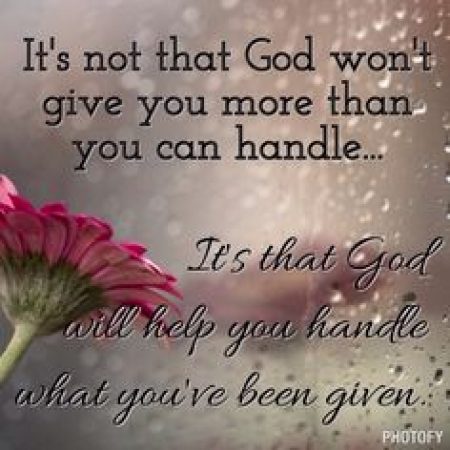
It’s not that God won’t give you more than you can handle, it’s that God will help you handle all that you’ve been given. We say something like this at most funerals when we say Psalm 23 –
Even though I walk through the valley of the shadow of death,
I will fear no evil: for thou art with me.
I have seen people live and survive through the roughest of suffering and tragedy BECAUSE they have believed this – that God is with them. And they have known that God is with them, because the church has shown them what God’s love looks like. It looks like showing up with a casserole, or a steady stream of encouraging texts, or a spontaneous lunch in the middle of a busy week, or a call for no reason other than to check in…. you know, because you’ve been on the giving and the receiving end of such love.
And I trust that when bad things happen, that God will sustain me, walk with me, hold me near, comfort and care for me. I can talk with God even if I can’t see him. He’s as close as the air I breathe, even if I can’t feel him. And I trust that though I might experience the pain of a traumatic event, at some point joy will overshadow the pain.
Annie Flint was born on Christmas Eve 1866 in a small New Jersey town. When she was three she lost her mother. Soon after that, her father became so sick that he could no longer take care of his children, and was forced to give them up for adoption.
She was taken in by a wonderful family named Flint. But before she finished high school, both her adoptive parents had died as well.
Annie had always wanted to be a teacher, and she was able to continue her education and become one. But not long after she began teaching, she was diagnosed with a degenerative disease that left her unable to walk or to live by herself. She spent the rest of her life (nearly 40 more years) in a wheelchair in a sanitarium where others took care of her physical needs.
And while she had to give up her dream of being a teacher, instead she began writing poetry. When her illness caused the joints in her hands to swell so painfully that it was hard to write, she began dictating her poems to others.
Her most famous poem is called What God Hath Promised:
God hath not promised skies always blue,
Flower strewn pathways all our lives through;
God hath not promised sun without rain,
Joy without sorrow, peace without pain.
But God hath promised strength for the day,
Rest for the labor, light for the way,
Grace for the trials, help from above,
Unfailing sympathy, undying love.
(That’s what we should all have printed on the back of our funeral bulletins!)
When you’re facing temptation, by all means turn to I Corinthians 10:13, and be reminded that God will help you find a way through the temptation.
But when you’re walking through hard times, it’s alright to admit, “I can’t handle this by myself, and I need help.” That’s why we have friends and doctors and neighbors and therapists and families and co-workers and THE CHURCH – brothers and sisters in the faith who come alongside to carry us through.
So if we’re not going to say God won’t give you more than you can handle, then what should we say instead?
Very simply, you can say, “The Lord IS with you, and I care!” OR
“This is terrible, and I have no idea why this is happening to you, but I believe that God is right close to you now more than ever.”
Remember:
God does not will all things, but in all things, God wills something. (~Lee Snook)
Here’s another:
Suffering is unbearable if you aren’t certain that God is for you and with you. (~Tim Keller)
And another:
Faith enables us to move through the storms carrying our calm with us. (~ J. Holmes)
Lastly:
God will help you handle all that you’ve been given.
A much better bumper sticker to be sure!
Amen.