Sermons at Union Congregational Church
Preached by The Reverend Gail L. Miller, Pastor
August 27, 2017 Twelfth Sunday after Pentecost
Exodus 1:8-2:10
Introduction to the Scripture reading:
Joseph and his family – including his father Israel and all his brothers – have reunited and relocated. Joseph has brought them all to Goshen in Egypt, since there is a severe famine in Canaan. Joseph continues as Pharaoh’s business manager and Pharaoh is generous with Joseph and his family. When Joseph’s father, Israel dies, he (Israel) gives blessings to his children and grandchildren, that they may become great nations. And they do become what we know today as the 12 tribes of Israel, or the Israelites.
Joseph lived on in Egypt caring for his brothers and their large families (at the time of Israel’s death there were 70 in the family). The family was multiplying as God had promised, and by the time Joseph died he had lived to see his great-grandchildren.
So our reading continues the story just after Joseph has died.
Exodus 1:8-2:10
Knowing And Not Knowing
And there arose a king who knew not Joseph.
All of history – turns on that one sentence, which begins our reading for today.
In fact, the people of Israel trace their history to this moment when a king came to power in Egypt who did not know Joseph, and his family, and more importantly his God.
And there arose a king who knew not Joseph.
And everything changed. This new king feared the growing population of Israelites, feared that they might join up with his enemies and turn against him, and so he made their lives miserable.
But as you heard in our reading – even under hardship, they thrived and grew! In fact they grew so much that the king turns to murder to control the population. All male children are to be killed by the midwives who bring them into the world.
But – the midwives feared God and not the king – and history turns again! The midwives are literally bringers of life who follow after God’s ways and not the ways of the murderous king, and so they let the little boys live.
And so the king again tries to thwart the growth of the Israelites by commanding every boy to be thrown into the river, which scares one Hebrew slave woman into hiding her newborn son.
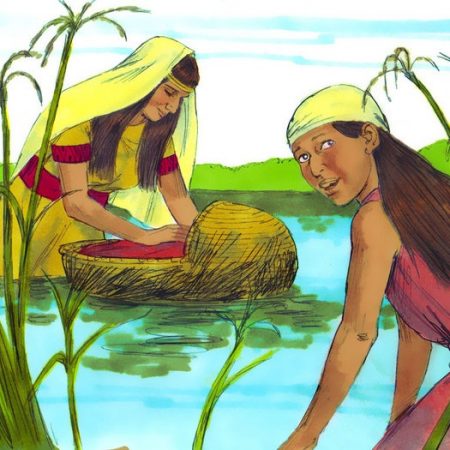
After three months, when she can hide him no longer she takes a basket, puts tar on it to make it waterproof, and puts the baby in it. She then hides it among the reeds at the edge of the Nile River. The baby’s older sister stands by and keeps watch. That same day the daughter of the king happens to come down to the river to bathe, where she finds the basket and its precious cargo. Taking pity on the little boy, she decides to keep the child.
And his sister steps forward and offers to find a nursemaid for the baby. The offer is accepted, and the child’s own mother is brought into the palace of the king to care for her own son – even though the princess knows nothing of this. The child grows, and is raised to manhood as the son of the king’s daughter. And the princess names the boy Moses.
And again history turns.
All because a king did not know Joseph and because the midwives did know God.
Did you notice that God seems to have had very little to do in the story? He’s only mentioned three times. The midwives fear Him in verse 17; and then in verses 21 & 22 God blesses the midwives with families.
But just because He is not named or explicitly visible in this story doesn’t mean that God is not at work in these events. Is it all coincidence or can we see God’s hand?
You’ve heard similar stories. Here’s one:
On the front porch of his little country store in Illinois, a small businessman stood with his partner. The business was failing, and the partner asked, “How much longer can we keep this going?” The owner answered, “It looks as if our business has just about dried up.”
Then he continued, “You know, I wouldn’t mind so much if I could just do what I want to do. I really want to study law. If only we could sell everything we’ve got, pay all our bills and have just enough left over to buy one book – Blackstone’s Commentary on English Law, but that’s not going to happen.”
At that moment a strange-looking wagon came up the road. The driver drove it up close to the store porch, looked at the owner and said, “I’m trying to move my family out west, and I’m out of money. I’ve got a good barrel here that I could sell for fifty cents.” The businessman’s eyes went along the wagon and saw the wife looking at him pleadingly, her face thin.
He slipped his hand into his pocket and took out the last fifty cents he had and said, “I guess I could use a good barrel.” All day long the barrel sat on the porch of that store. His partner kept teasing him about it until late in the evening he walked out and looked down into the barrel. He saw something in the bottom of it, papers that he hadn’t noticed before.
His long arms went down into the barrel and, as he fumbled around, he hit something solid. He pulled out a book and stood dumbfounded: it was Blackstone’s Commentary on English Law. And the Illinois store owner was Abraham Lincoln.
And again, history turned. Coincidence or God’s hand?
The theological principal at work here is providence. Providence comes from the two Latin words pro and video – which mean to see before or to see ahead. One scholar describes providence as “the concept that you are blessedly unaware of the fact that God is aware of your needs.” (Rolf Jacobson, Crazy Talk, p. 138)
The providential work of God is not always plain and clear to us. We may not even realize that it is God who is acting. Only later, at some future time, when we look back over our lives, and the truth is revealed, do we come to see the hand of God. And we say, “Oh yeah. Now I understand what that was all about!”
Coincidence may be God’s way of acting anonymously in your life.
Since the Reformation 500 years ago, the Protestant tradition has taught that the last word in every human situation is always the grace of God – God’s grace will have the final say. This means that God’s grace can be, and is, experienced in the ordinary affairs of our lives.
In other words: God takes all the various circumstances of our lives – even when they are far, far less than perfect; and, over time, fashions something good and useful out of them.
As Paul says, “We know that in everything God works for good with those who love him.” Everything. Not some things. Not just happy things. Everything – by providence and grace.
As Christians, our unique testimony to the world today is that God’s grace is the last word. In every human situation, whether it is an historical event that overwhelms us or a personal event that threatens us, God’s grace is there.
But this grace is not just a human attitude that helps us stoically face whatever happens to us. God’s grace is the personal activity of God in your life and mine that opens up for us new possibilities in every situation. And that gives us hope, hope that beyond every defeat, every disaster, every disappointment, God’s good purposes are working themselves out in our lives.
This does not mean that there are no difficult times. Of course there are. And the pain, the isolation, the suffering is intense and very, very real. But, real as these are, they are not the last word. God has the last word, and it is always grace.
As that old favorite hymn says:
Through many dangers, toils and snares I have already come.
’Tis grace that brought me safe thus far, and grace will lead me home.
The story of Moses birth, the story of Jesus, even the story of Abraham Lincoln reveals God’s providence, the awesome working of God’s grace in very human lives. And these stories inspire us to look back through our own lives, to consider where we’ve come from, and how God’s hands have rested upon us.
I invite you to do that. Look back at your own life. Look back along the path that has brought you to where you are today – in your career, or in your family, or your friendships, or your schooling.
Where are the corners you turned deliberately, perhaps even painfully – but only later came to understand just why?
How about the long, lazy curves you rounded almost imperceptibly – and only much later did you realize how the landscape had changed and how permanently!
Or maybe that understanding hasn’t quite come yet.
Do you see the patterns of the grace of God at work in your life? Can you see how, by God’s grace, we live our lives not in quiet desperation, but in grace and power and peace, even as we face the challenges of today?
God’s grace is sufficient for whatever comes our way. This is the heart of our faith. The grace of God is at work for good, even if the road is rough and the journey difficult.
The cliché is true – it’s not what you know that matters, but who you know.
Think about it. The midwives knew God and they were blessed.
The final word – always – is God’s grace.
Amen.