Sermons at Union Congregational Church
Preached by The Reverend Gail L. Miller, Pastor
March 26, 2017 Fourth Sunday in Lent
I Samuel 16: 6-13
John 9: 1-42
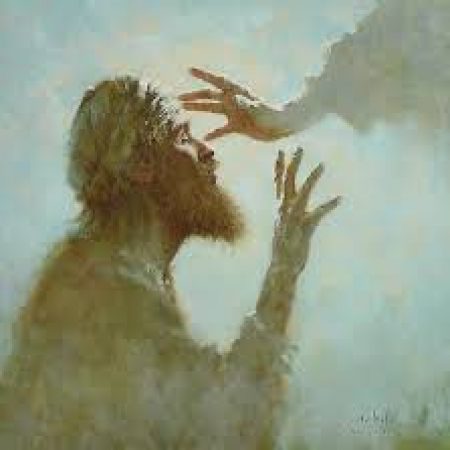
‘Twas Blind, But Now I See
The Bible is the story of constantly opening eyes. Sometimes we get miracle stories, like today (John 9). Other times, we are just told that people see God.
It is also, you could say, one big story of being forgiven and accepted over and over, and over and over – because, as we all know, it is human nature to muck things up.
You know the stories:
God gives the Garden. Adam and Eve slip up.
God sends a rainbow after the flood, and says, let’s try again.
God sends Moses and the law and the burning bush and the people say yes, only to really say no with their actions.
God forgives them. The people stay on God’s path again for a while…and then they wander away again.
Repeatedly, the people of God go blind to His presence in their lives.
Finally, God sends Jesus, his only son, to say, “I still love you – more than you can imagine in fact.” The entire story of the Bible can be summed up in one repeat motion: God hounding His people with love, but the people not quite seeing.
And these patterns continue still today, with us. I suppose it is some consolation that we are in good company with the early disciples and the ancient Israelites. Well, our two lessons today are great examples of this.
When God chooses the next king of Israel from Jesse’s sons, once again He is reaching out in love and providing for the welfare of His people. In fact that’s how this chapter begins: God says to Samuel: “I have provided for myself a king among [Jesse’s] sons.”
The Hebrew word that is translated here as provided literally means to see; in the way that we would say, “I have seen to it.” Again, God has “seen” the people’s need even before they are aware of it. The very word provide means to see before – pro video, in the Latin.
Though God’s guidance is often not as obvious to us in the moment as it is in hindsight. Most of the time, it’s hard to know what God is doing in our lives or how God is leading us.
Well, the drama of this story is wonderful. Jesse brought each of his first seven sons before Samuel to see which son would be anointed as king. When the eldest son, who was tall and good looking, passed before Samuel, he thought, “Surely the Lord’s anointed is now before the Lord.”
But God’s surprising response has echoed down through the ages:
Do not look on his appearance or on the height of his stature, because I have rejected him; for the Lord does not see as mortals see: they look on the outward appearance, but the Lord looks on the heart (v. 7).
And then six more fine sons, all with the same reaction, “Nope, not him.” Because God knew that there was one more son – the youngest and of such little account that Jesse had left him out in the field tending the sheep.
Now, in those days, the shepherd was a symbol of the king. And ancient people hearing this story would have been touched by the irony that the one who was thought to be too insignificant to be considered for the role of king was actually already fulfilling his future vocation: shepherding the flock. And then when David was brought in, the Lord said, “Rise and anoint him; for this is the one.”
And while God SEES ahead, Samuel’s job was not so much to see as to listen: “You shall anoint for me the one whom I name to you.” The message is clear. When looking for God, sometimes human sight is inadequate.
Because seeing can be deceiving. Even though we rely on our sight for almost everything, it often proves untrustworthy. Advertisers know that the quickest way to get into our wallets is through our eyes—by bombarding us with images of excess. Do we really think that driving same car as Matthew McConaughey will make us more attractive and successful?
What a powerful, counter cultural message this is! Thus says the Lord: “The Lord does not see as humans see: they look on the outward appearance, but the Lord looks on the heart.”
What we see with our eyes is not always what God sees with His. The story of the blind man in the Gospel of John also makes the point that perfectly good eyes can’t always see the truth.
Over the course of this story, the man born blind moves from one level of sight to another. First, he confesses Jesus as the man who healed him. Then, he confesses Jesus as a prophet, and finally he defends Jesus before the Pharisees. “He is of God, He is the Son of Man,” and worships him as Lord.
The Pharisees however, move from one level of blindness to another. They doubt the miracle. They seek to prove it never happened at all. They condemn Jesus for healing on the Sabbath. And finally, they claim Jesus is not from God.
What a contrast between those left in darkness and the one who has new vision. The man who receives his sight for the first time sees Jesus. What joy! The Pharisees see Jesus, but they see him only as a Sabbath breaker, a sinner, a threat to deal with. How sad!
The story goes of a beggar who was sitting across the street from an artist’s studio. The artist saw him and thought he would make an interesting subject of a portrait. So from a distance she painted him. When she was finished, she took the portrait over to the beggar so he could see it.
“Who is that?” he asked. He saw in the painting a slight resemblance of himself, but the artist had painted a person of dignity, with squared shoulders and bright uplifted eyes, almost handsome! He asked the artist, “Is that me? I don’t look like that.” And the artist replied, “but that is the person I see in you.”
Through the eyes of Christ, we do see ourselves and others differently. The risen Lord comes to us and says: “Look, this is the person I see in you, and look, this is the person I see in her, and in him.”
Fanny Crosby was a great Methodist hymn writer from New York (19th C.). She wrote thousands of hymns; and she was blind from infancy as a result of an accident. When she was only eight years old she wrote this little rhyme:
Oh, what a happy child I am,
Although I can not see.
I am resolved that in this world,
Contented I will be.
How many blessings I enjoy
That other people don’t.
To weep and sigh because I’m blind,
I cannot and I won’t!
She also wrote:
It seemed intended by the blessed providence of God that I should be blind all my life, and I thank him for the dispensation. If perfect earthly sight were offered me tomorrow I would not accept it. I might not have sung hymns to the praise of God if I had been distracted by the beautiful and interesting things about me.
She lived to be over 90, and that beautiful, rejoicing spirit characterized her all her days. “When I get to heaven,” she said, “the first face that shall ever gladden my sight will be that of my Savior!”
The point is that you don’t need to possess special knowledge to see Jesus and who he really is. It’s more about acknowledging that knowing.
The formerly blind man did not know all the correct religious phrases with which to interpret his healing. He was not pious in the traditional sense or even respectful of his elders. What he knows for sure is that once upon a time he sat in darkness, and now the whole world was drenched in sunlight. And he acknowledged that.
“One thing I know,” he said, “Once I was blind; but now I see.” And he makes his witness to Jesus.
“One thing I know,” one of you might say, “is that when I was going through my divorce I hurt so much I couldn’t sleep or eat, and I was so filled with hate I couldn’t think, but somehow I got through it, and I’ve come to recognize that the somehow was Jesus.”
“One thing I know, is that when we thought we were at the end of the rope, that we’d reached bottom, a calm came over me and then things began to pick up and I really felt the peace of God.”
“One thing I know.”
How is that for ironic understatement? As if the only little thing you happen to know is – that Jesus saved your life! You don’t start with special knowledge but with acknowledgment.
We move slowly, one day or even one moment at a time. Every day’s challenges take their toll. But that’s all right. Because, starting over is what Christians do best.
And important to remember is that we do none of this alone. The one whom the Father sent doesn’t abandon us in our confusion, in our sadness or in our struggles. Even in our blindness, especially in our blindness, God provides for us.
That’s what these weeks of Lent are all about – really taking in the depth of God’s love and sacrifice for us and for the world, allowing Jesus to give us new eyes with which to see; so that with the blind man, we can proclaim with perhaps a bit more confidence:
Lord, I believe.
Amen.